

Reserve fund studies, with the statistics built in.
A building's longest risk is the one it pays for slowly: roofs, garages, windows and the reserve fund behind them. Musemakweli Reserve is two products on one engine. Reserve Workbench helps engineers and other study providers prepare studies faster and defend the funding plan. Reserve Compass turns the finished study into something a board member can read over coffee. Both show what a single-forecast study can't: how often the plan gets through, and what more cushion would cost.

Two products, one engine
Reserve Workbench
Prepare a Class 1, 2 or 3 study in one place, from last cycle's report to this year's.
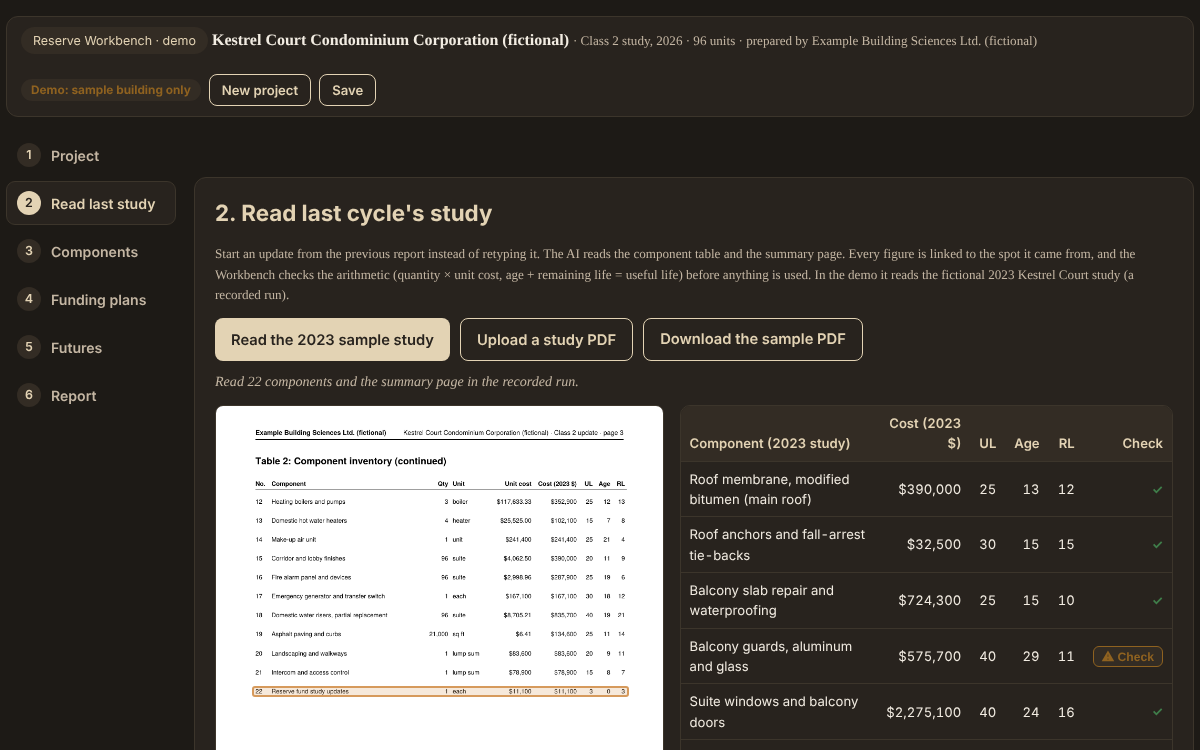
- AI reads the previous study. It pulls every component, quantity, cost and life, and links each figure to the spot on the page it came from, so you check and don't retype.
- Ontario component templates with typical lives and cost ranges, then your own library.
- Condition ratings that update remaining lives, as a range for the provider to review and adopt or change.
- Funding plans: Full, Baseline and Threshold (as the Community Associations Institute's reserve study standards define them), plus our Confidence plan, side by side per unit per month.
- A statistical appendix written for engineers, and a report builder.
- One-click roll-forward for the next update.
- Hail and wind from Musemakweli Extremes: how storms shorten roof and envelope lives, and the extra contribution.
Reserve Compass
Your reserve fund study as a dashboard, in plain English, between studies.
- A health score out of 100, calculated by the software from your study's own figures and the stated method, that shows what is holding it back. It is not an opinion on your fund or on your provider's work.
- The outlook in words: "gets through in about 8 of 10 futures".
- What's coming up, year by year, and what it means for your unit.
- What-ifs: raise fees 3%, delay the garage two years, see the score move.
- Ask your study: AI answers to your questions, drawn from your study's text and linked to the page. Answers can be wrong; check them against the study, and take advice from your provider.
- A board meeting report and a project tracker.
- A weather and climate line: the chance of damaging hail or wind before the roof is due.
What the statistics add, explained two ways
The same ideas, at two depths. Pick yours.
2,000 futures, not one
A reserve study is one forecast: one inflation rate, one interest rate, every job on time and on budget. Real life wanders. We replay the next 30 years 2,000 times, with costs, interest and timing moving within ranges set by stated judgement and informed by Statistics Canada and Bank of Canada history (not fitted to it), and count how often your plan gets through without a special assessment. Think of a weather forecast: "70% chance of rain" is more useful than "it will rain".
A bivariate AR(1) for log construction-cost inflation and the fund rate (correlated shocks, compensated jumps for 2022-type years, a five-year ladder), lognormal estimate error by volatility class with a building-wide shared factor, and truncated ±2-year timing. Per-path, per-component random streams; every run is shown under your rates and under the historical cost-over-interest gap.
A health score that explains itself
One number out of 100, like a fitness tracker for your reserve fund. It's built from three things you can see: how often the plan gets through the next 30 years without a special assessment, how often it gets through the next 10, and how much is saved compared with the wear and tear so far. Tap it and it shows you which part is holding it back.
Score = 100 × (0.4 × share of futures holding to the horizon + 0.3 × share holding 10 years + 0.3 × min(percent funded, 1)). Bands at 80, 60 and 40. Percent funded is the opening balance over the fully funded balance, Σ cost × age ÷ useful life (the Community Associations Institute's definitions). Each part is shown, and the score is also given under the historical gap.
Remaining lives that learn from condition
A roof's "25-year life" is an average. Yours may last longer or shorter depending on what the engineer sees on site. The Workbench starts from typical lives for that kind of roof and updates them with the condition rating, like a doctor adjusting an estimate after an exam. The result is a range, not a single year.
Total life L is lognormal with the template range as its 10th-90th percentiles. A condition rating at age a is a noisy reading of the share of life used: ln(a/L) = ln u_c + e, e ~ N(0, 0.25²). The conjugate update on ln L gives the posterior; remaining life is L − a given L > a. In the futures, the first replacement year can be drawn from this posterior.
The cheapest plan that holds in 9 of 10 futures
Instead of "contribute $X", the board sees three or four plans side by side, each with what it costs per unit per month and how often it gets through. The Confidence plan is the cheapest one that holds in, say, 9 of 10 futures, so the board can choose how much cushion it wants to pay for.
The no-action balance is linear in the plan's year-1 amount, B = A + C₀D with D > 0, so each future needs C₀ ≥ cᵐ = maxₜ (Mₜ − Aₜ)/Dₜ, and the cheapest plan meeting a share q is the order statistic c₍⌈qN⌉₎. It is exact, and it is checked against bisection. The usual Full, Baseline and Threshold goals are solved the same way on the deterministic table.
What Musemakweli Reserve adds
| Question | Musemakweli Reserve |
|---|---|
| Will the plan work? | 2,000 futures: how often it gets through, and how badly it misses when it doesn't |
| What if costs outpace interest? | Always shown side by side with your assumptions |
| How long will it last? | A range that updates with the condition rating |
| How much should we contribute? | Full, Baseline and Threshold (the Community Associations Institute's definitions), plus our Confidence plan: the cheapest plan that holds in 9 of 10 futures |
| Health score | Three visible parts, and the method documented (overview public, full technical note on request) |
| Retyping the last study | AI reading, with each figure linked to its page for the provider to check |
| Ontario first | The Condominium Act's 30-year horizon, Class 1-3 studies, PEO's software guideline |
Plans and pricing
Two products on one engine. Prices in CAD, plus HST.
Paid plans are by request. While we onboard our first clients, anyone can request access. We review each request, and once yours is approved you choose a plan and pay securely through Stripe. Already approved? Sign in.
Founding pilot: the first five Ontario study-provider firms get three Workbench studies free, in return for a 45-minute interview about your workflow and feedback as you use it. Join the founding pilot → Boards can also join the Compass waitlist.
Reserve Workbench, for study providers
Demo
- A guided tour of the Workbench on the fictional sample building
- The AI reader on the sample study (recorded run)
- Every step, read-only, with the board's what-ifs (inflation, interest, the contribution) live
- No own projects, uploads or exports
Per study
- One project for 12 months
- The AI reader on your previous study and other PDFs
- Your report (PDF and Word), CSV and the inputs file
- 10,000 futures in paid studies (2,000 in the demo), the statistical appendix and the technical method note
- A Compass link for the board, on the free plan
- $95 for a Class 3 update
Firm
- Unlimited studies, up to 5 users
- Your firm's component library and cost data
- Your logo and report layout
- One-click roll-forward for updates
- Lives that learn from your own condition history
- Compass Premium free for every client board for the first year from publishing, then the free plan
- Compass Premium for your own use: upload any study and see what the board sees
Founding pilot
- For the first five Ontario study-provider firms
- In return for a 45-minute interview about your workflow and feedback as you use it
- Your feedback sets what we build next
Reserve Compass, for boards and owners
Free
When your provider prepares your study in the Reserve Workbench and sends you its Compass link. No account needed. Anyone can try it on the fictional sample building.
- Your study in plain English
- The health score and the outlook in words
- What's coming up, and your unit's share
- Alerts: study update due, large work ahead
- 2 what-ifs
- No upload of your own study (that is Premium)
Premium
- Unlimited what-ifs
- Ask your study: AI answers from your study, linked to the page (they can be wrong)
- The board meeting report
- The project tracker, planned against actual cost
- Upload a study from any provider (the AI reads it)
- The technical method note
- Free for the first year when your provider is on Workbench Firm and publishes your study
Property managers
- One view across the corporations you manage
- Which studies are due, and where large work is coming
- Planned for spring 2027
Join the founding-firm pilot → · Request Compass Premium for your board →
Who builds it
Built by Rolly Molisho, FCIA, CERA, MSc Data Science (Statistics), University of Leeds, in London, Ontario. Actuaries spend their careers putting numbers on uncertain futures and explaining them to people who have to decide. Musemakweli Reserve brings that to reserve funds. It takes one figure from the Canadian Institute of Actuaries research paper Longevity of Infrastructure – Reserving and Risk Management in Condominium Maintenance in Canada (Côté and Juffs, 2022): the 2001–2020 gap between construction costs and fixed-income returns, used for the historical-gap runs. The paper's call for a financial cushion against unexpected costs is close in spirit to the Confidence plan. The paper is cited as context, not as an endorsement.
The study itself stays the provider's: in Ontario, reserve fund studies are prepared by qualified providers such as engineers. The software helps them prepare it and helps boards understand it.
Questions
- Will it contradict our study?
- It starts from it: with the statistics switched off it reproduces the study's table to the cent. The futures then show how far real costs and rates could move from the study's single forecast. They are not a second opinion on the study. The futures show how far real costs and rates could move from it.
- Who signs the study?
- The provider. The Workbench produces the provider's report under the provider's name.
- Can a board use Compass with a study from any firm?
- Yes, with Premium: upload the study and the AI reads it. Boards whose provider uses the Workbench get the free plan through the provider's link, and Premium for the first year when the provider has Workbench Firm.
- Where is our data kept?
- The demos run entirely in your browser and send nothing. On a paid plan, your projects are kept on your Musemakweli account, stored in Canada, and their futures are computed on our servers there. A study PDF is opened in your browser; only its text is sent, to our AI document-reading provider in the United States, and neither the file nor the text is kept by us (see Privacy & data for how long the provider holds it).
- Does it allow for storm damage?
- Yes, as an option. Step 6 of the Workbench uses hail and wind chances from Musemakweli Extremes to bring roof and envelope replacements forward, and shows the extra contribution. Compass shows the same in plain words. The thresholds stay the provider's to set.
- BC, Alberta and the rest of Canada?
- Ontario first. BC's depreciation reports and Alberta's reserve fund rules are next.
Financing, presales or refinancing? Studio covers the earlier stages of a building's life. Storms and heat? Extremes measures the weather a building faces, and feeds the Workbench and Compass.
This page is product information from Musemakweli Risk Inc. On Workbench reports the footnote reads: Prepared by the preparing firm for the board of the corporation using Musemakweli Reserve software. The preparing provider is responsible for the study and its inputs. Decision support: not engineering, legal or financial advice.