

The engines and research behind Studio, Reserve and Extremes.
Three products, two engines, a governed AI workflow and a research note, ordered by the building's life: financing, operation, the reserve fund and climate. Each states the question, the method, where it came from and its status. All of it uses public methods and public or fictional data, never any employer's models, data or clients. None of it is advice. How I keep it separate from my job →
Studio · Reserve · Extremes · Control Room · CRE Engine · EWST Engine · Research note · Professional service and speaking
Products
Studio, Musemakweli Reserve and Musemakweli Extremes are the products: self-serve software for the people who answer for a building, from its financing and its reserve fund to the weather it faces.
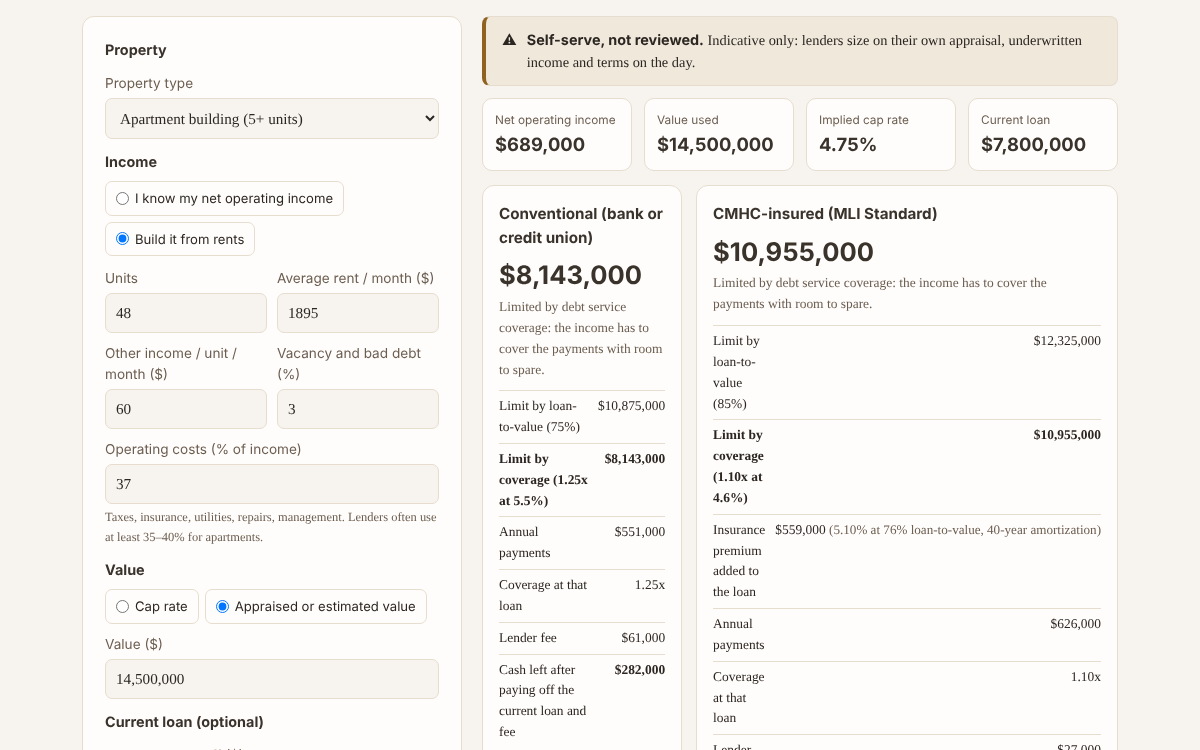
Studio
Question. How much will a lender lend on my building, does my for-sale phase survive slower sales and higher costs, which term sheet is cheapest over ten years, and which of my loans will struggle to refinance?
Method. Lender sizing tests with CMHC's premium grid and MLI Select tiers; 5,000 simulated outcomes with prices and sales pace moving together on HST-correct revenue; moderate and severe downside sets; an illustrative credit-model lens from the CRE Engine.
Status. Explore is free and runs in your browser. Paid plans from $90 a month, or a $690 Project pass for one phase, by request while we onboard the first clients. A founding pilot gives the first five developers, builders or owners six months of the Developer plan free in return for feedback.
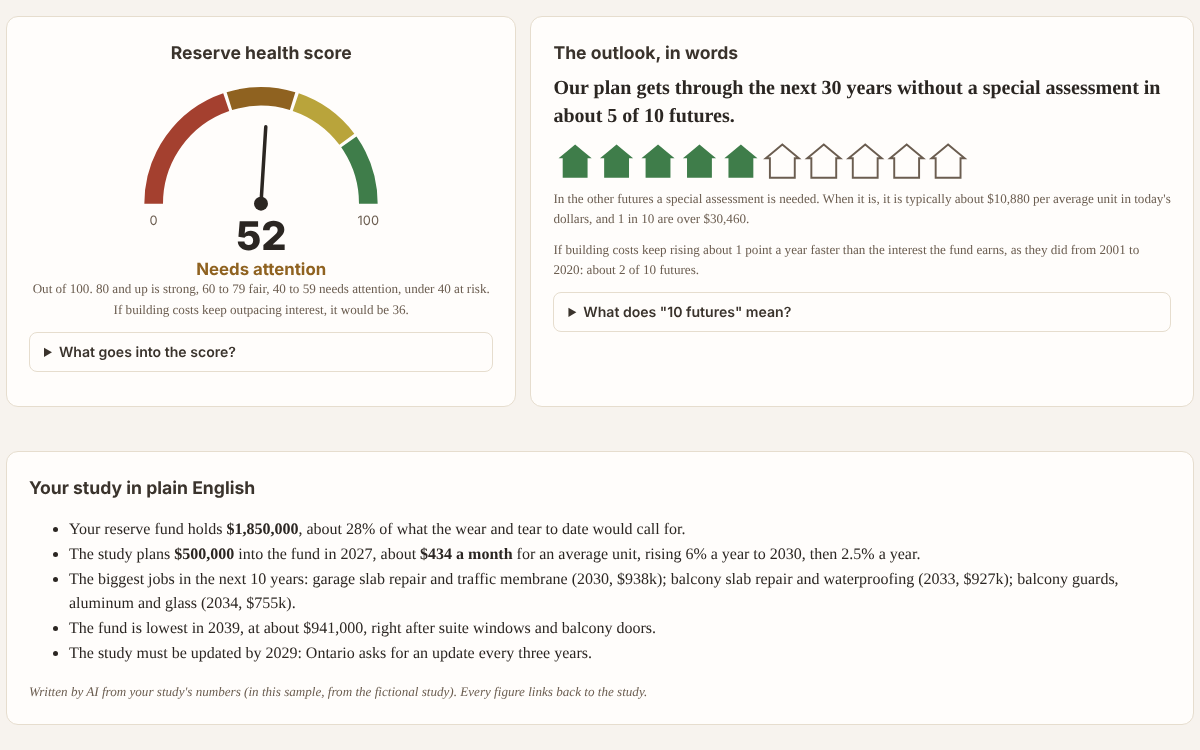
Musemakweli Reserve
Question. How often does a condominium's funding plan get through without a special assessment when building costs, interest and timing move, how long will each component really last, and how do we explain that to a board?
Method. The provider's table reproduced to the cent; 2,000 futures of correlated cost inflation and fund interest, estimate error and timing; remaining lives updated from condition ratings by Bayes' rule; an exact solver for the cheapest plan that holds in a chosen share of futures; a health score with visible parts.
Status. The Workbench demo and Compass free plan run in your browser. Paid plans are priced (Workbench $190 a study or $390 a month for a firm; Compass Premium $59 a month), by request while we onboard the first clients: once access is approved, you choose a plan and pay through Stripe (sign in or request access). A founding pilot gives the first five Ontario study-provider firms three studies free in return for feedback, and the board waitlist is open.
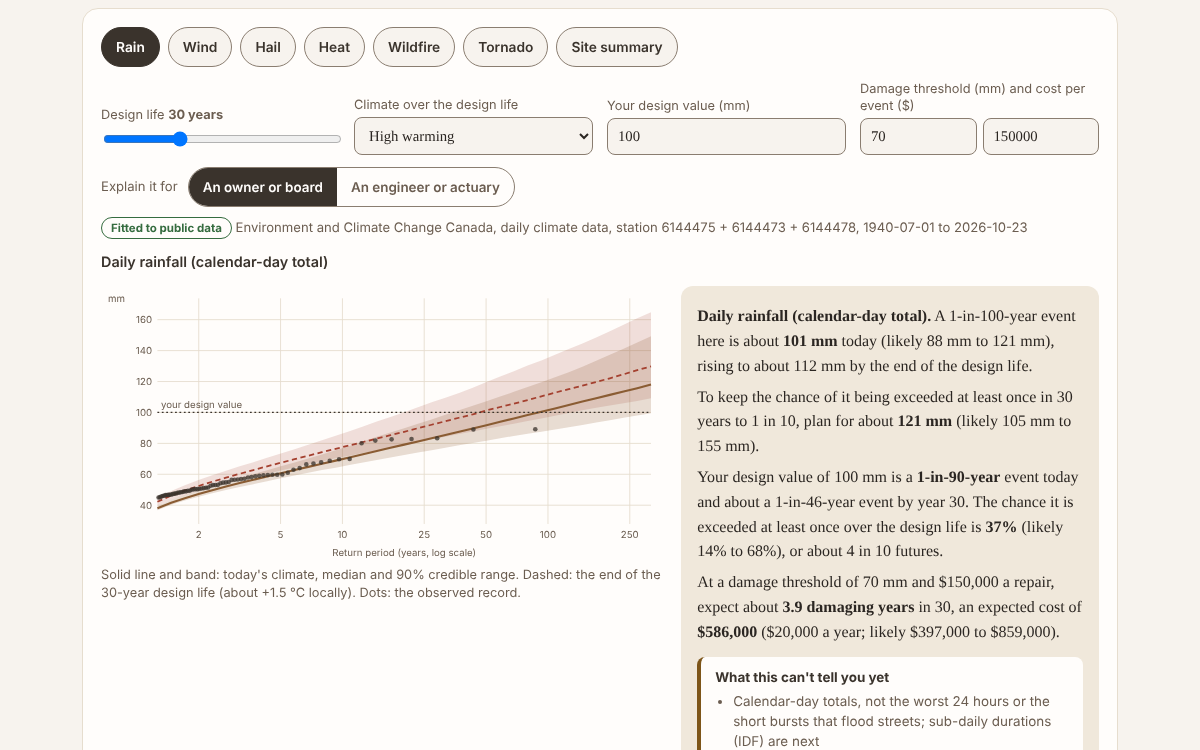
Musemakweli Extremes
Question. How big is a 1-in-100-year storm, gust, hailstone, heat day, wildfire or tornado at this site, how likely is it over the asset's design life as the climate warms, and what is it likely to cost?
Method. Peaks over threshold and annual-maximum models fitted by Bayesian methods to public data, with stated shape priors and an uncertain climate sensitivity in every draw; design-life levels (Rootzén and Katz); expected cost from damage thresholds; SSP2-4.5 and SSP5-8.5 by calendar year; construction-period weather from daily records; accumulation screening for insurers, with indicative loss curves; a simulation study of interval coverage and out-of-sample checks on later years. It grew out of the rainfall research note below.
Status. The London preview and read-only previews of the Portfolio register and Pro run free in your browser. Paid plans are priced (Site Report $190, Portfolio from $2,400 a year, Municipal from $3,600 a year, Pro $290 a month a seat; accumulation for insurers by quote), by request while we onboard the first clients: once access is approved, you choose a plan and pay through Stripe (sign in or request access). A founding pilot gives the first three municipalities and three engineering firms a year of Portfolio or Pro free in return for feedback. Tornado comes from Environment and Climate Change Canada's Canadian tornado database.
Engines and showcases
The CRE Engine, the EWST Engine and the Control Room are showcases: they demonstrate the methods behind the products and are shared by access code for discussion, not as services.
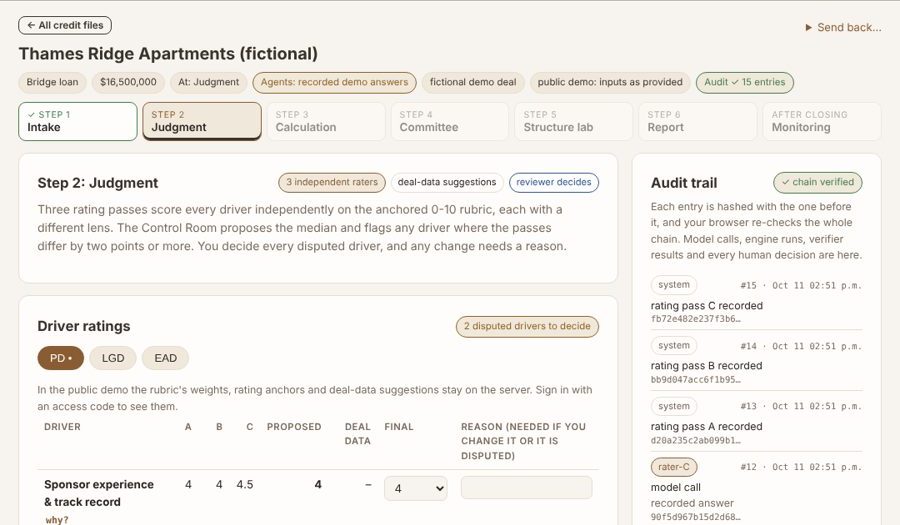
Control Room
Question. How can AI agents speed up credit and capital work without taking the decision, or the numbers, away from people?
Method. Agents read deal documents and loan tapes, propose inputs and ratings, and draft credit memos, monitoring reviews and the stress-testing section of an ICAAP. The CRE and EWST Engines compute every number, and Musemakweli Extremes adds each file's physical climate risk, written into the memo by the engine rather than an agent. Named reviewers approve each step, enforced by the server. Every figure in a draft is matched to engine results before it can be approved, and every action is written to a hash-chained audit trail that anyone can verify.
Origin. My own independent work.
Status. A showcase, not a service. The public demo runs on two fictional files with recorded agent answers, open to anyone with no sign-in. Access codes for your own documents or figures are issued for discussion of the work, and never to banks, credit unions, mortgage investment corporations, credit funds or other lenders, or their staff, while I am employed in banking.
 Showcase · commercial real estate credit risk
CRE Engine
Question. How would a scorecard built from public methods and an illustrative benchmark rate a project and its financing, how do coverage and the refinance hold under stress, and which changes move the risk most? It does not replicate any lender’s internal model.
Method. Bayesian PD, LGD and EAD scorecards: structured expert judgment on an illustrative benchmark (Musemakweli's judgement) forms the prior, updated with observed experience where it exists. Cashflow and covenant stress tests; physical climate risk from the Musemakweli Extremes hazard at the property (expected weather cost, weather-driven covenant breaches, and the PD and expected-loss add-on); and repayment models for term, condo inventory, bridge and repositioning loans.
Origin. My own independent work, from public methods and my MSc research. Its default risk drivers and weights were drafted with AI agents and reviewed by me.
Status. It powers the illustrative credit-model lens in Studio. Access codes are issued for discussion of the work. The CRE Engine is not available to lenders.
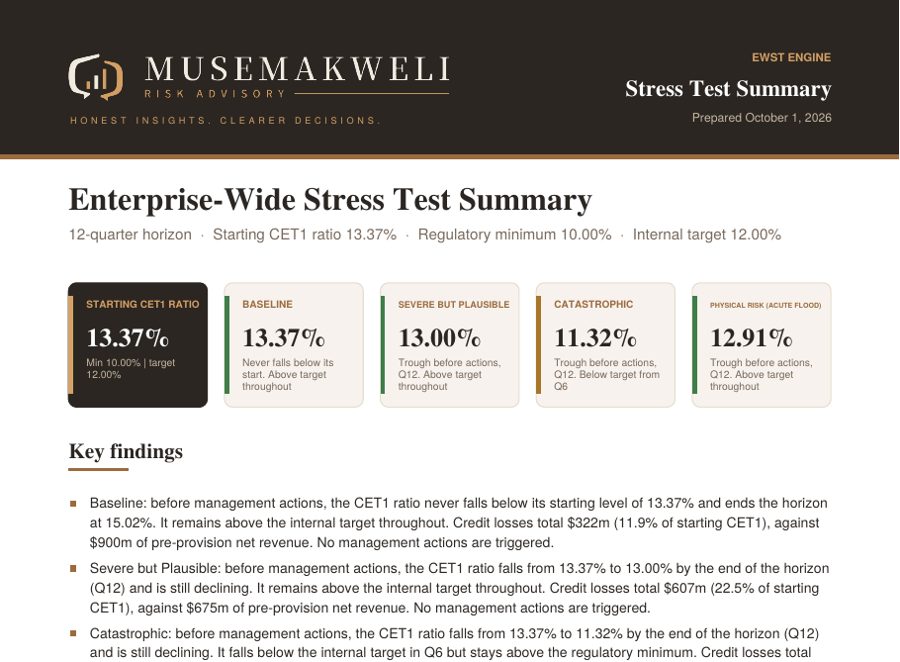 Showcase · enterprise-wide stress testing
EWST Engine
Question. How does a coherent multi-year macroeconomic scenario flow through a credit portfolio to losses, risk-weighted assets and capital, and when would management actions be triggered?
Method. Multi-period scenarios for house prices, GDP, unemployment and the policy rate, transmitted through segment-level PD, LGD and CCF to credit losses, risk-weighted assets and CET1 capital, with thresholds and management actions; a physical-risk scenario calibrated from Musemakweli Extremes return periods.
Origin. My own independent work, on a fictional institution. No institution's internal data is used.
Status. A showcase, not a service. The sample report is public and the stress-test demo runs in the Control Room with no sign-in; the engine itself is shared by access code for discussion of the work.
Research notes
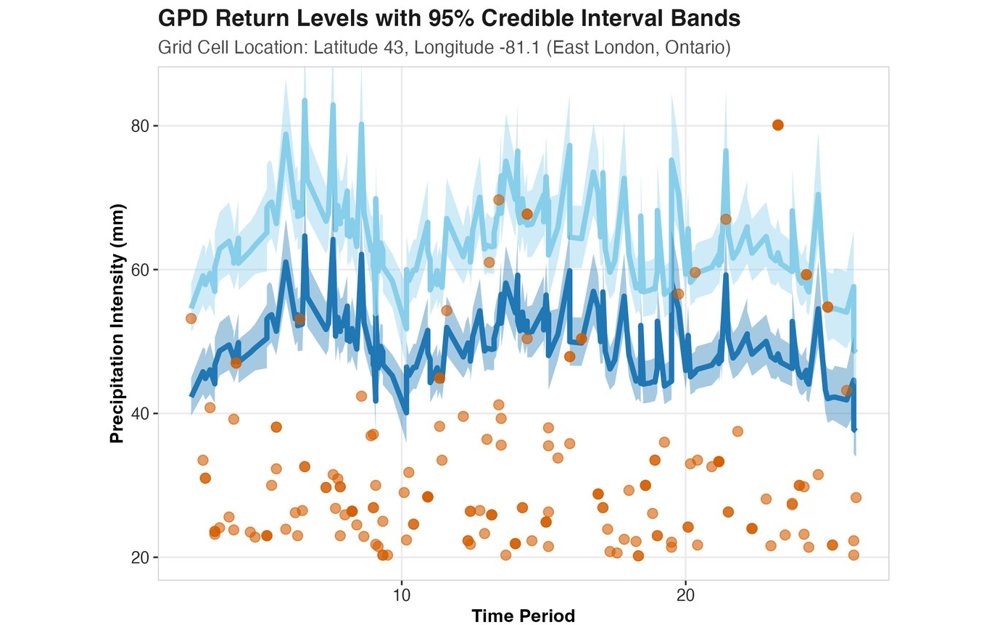
How heavy is the tail? Extreme rainfall in London, Ontario
Question. How intense is a 1-in-5- or 1-in-100-year daily rainfall across London, how does it vary with conditions, and what does it mean for the people who build, own and insure on the land?
Method. Peaks over threshold with a generalized Pareto distribution whose parameters follow a generalized additive model; posterior simulation for uncertainty; calibration to Environment Canada's published levels.
Data. ERA5-Land reanalysis (Copernicus Climate Change Service) and Environment and Climate Change Canada data (Open Government Licence – Canada), 2000–2025.
Status. Version 1 (2026). Its method now runs in Musemakweli Extremes, fitted to 85 years of gauge records; a revision of the note with cluster-robust uncertainty is in preparation and will be published with a change log.
Read the research note →Professional service and speaking
Chair, Banking Committee, Canadian Institute of Actuaries
A volunteer role. The committee works to extend actuarial practice beyond its traditional home in life and P&C insurance into broader banking functions. Views on this site are my own, not the CIA's.
Available to speak
I welcome invitations to speak to industry associations, conferences, universities and actuarial and risk groups. Topics I can bring, with live examples from the showcases above:
- Governed agentic AI in credit risk: where agents help, and where people must decide
- Estimating risk when defaults are rare: expert judgment and Bayesian updating
- Stress testing from macroeconomic scenario to capital
- Extreme rainfall and physical risk for property, from data to decisions
Education and designations
- MSc Data Science (Statistics), University of Leeds. Capstone research: When Sewers and Basins Fail: A Tale of a Dynamic Tail? (2026)
- Bachelor of Business Science in Actuarial Science, University of Cape Town
- Fellow of the Canadian Institute of Actuaries (FCIA)
- Chartered Enterprise Risk Actuary (CERA)
- Fellow of the Actuarial Society of South Africa (FASSA)
Want to discuss a piece of work?
For research, speaking, professional enquiries or an access code to the engines or the Control Room, send a short note. Developers, builders and owners: try Studio; engineers and condo boards: Reserve; municipalities, owners and insurers: Extremes.
Get in touch